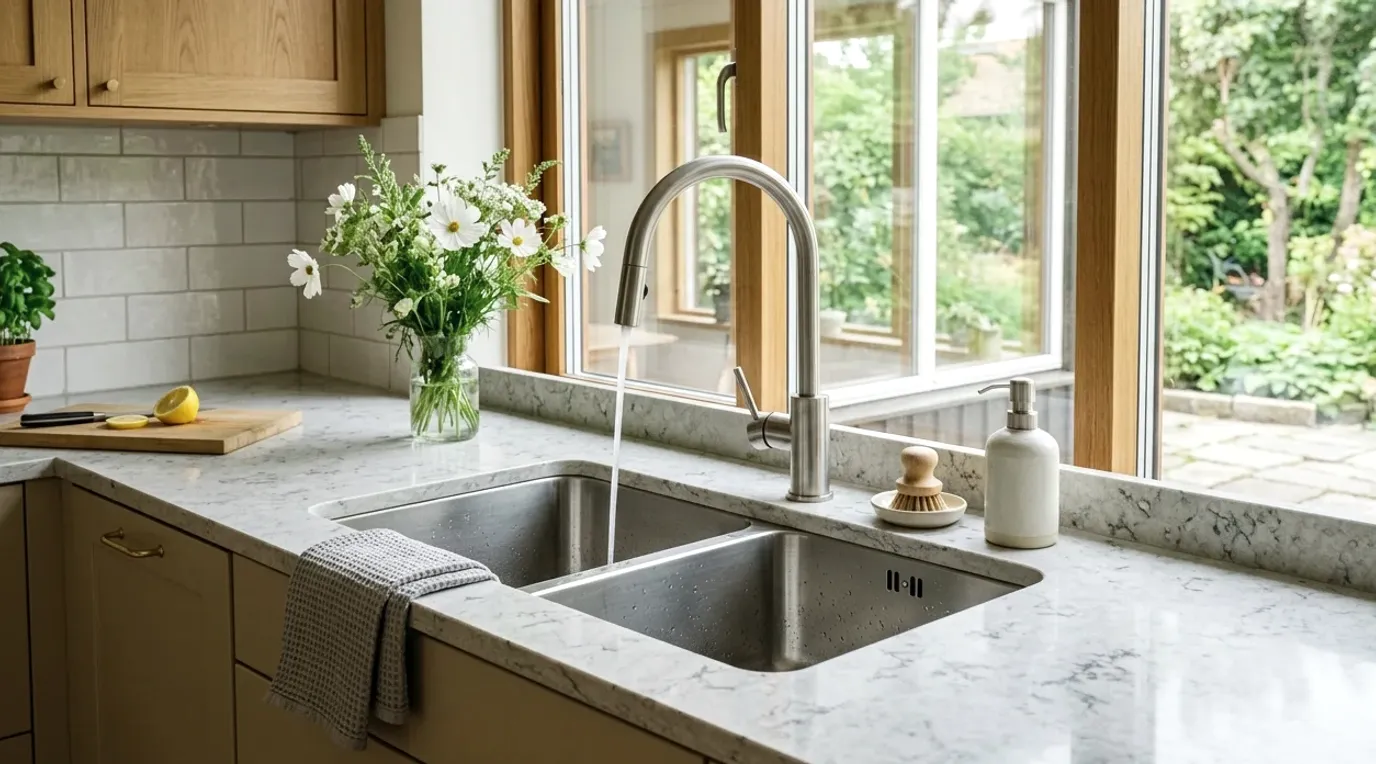
A new sink is a small purchase next to a counter, which is why people buy the sink first. That order is backwards when you are trying to keep the counter. The new basin fits only if the existing cutout, the way the rim sits, and the faucet holes all agree with it. If they do not, you are looking at a fabricator visit or a new top, not a Saturday swap.
Modern Kitchen San Diego is a referral service. We do not cut counters, set sinks, employ crews, or set prices. You contract with an independent remodeler. Have that remodeler, and the fabricator if stone is involved, look at the top before you buy the sink. Check the license at cslb.ca.gov before you sign anything that includes cutting or plumbing.
The cutout, the reveal, and the holes have to match
Three facts decide the job. The cutout is the hole in the counter. The reveal is how much of the sink’s rim you see, or do not see, once it is mounted. The faucet holes are the openings in the sink deck or in the counter, and they have to match the faucet you are keeping or the faucet you are adding.
Bring the spec sheet, not a showroom photo. You want the cutout size the maker publishes, the overall rim size, the basin depth, and the number of faucet holes. Compare those to the sink that is already in the counter. A basin that looks the same width in a photo can still need a larger hole, a smaller hole, or a different front-to-back depth. Smaller is often worse than larger, because filling in a stone or laminate hole is not a normal part of a sink swap.
If the faucet is staying, count the holes it uses and note whether it mounts on the sink or through the counter. A faucet that needs one hole will not cover a three-hole deck by itself. A base plate might, if the spread matches. If the faucet mounts in the counter, those holes are a stone or laminate problem, not a sink problem. The remodeler should see them before anyone orders a fixture that assumes a different deck.
Drop-in and undermount are not interchangeable
A drop-in sink hangs from a rim that sits on top of the counter. The rim hides a rough cut and clamps from below. An undermount sink fastens under the counter, so the edge of the hole has to be finished and strong enough to show. Those are different holes.
You can sometimes set a new drop-in in a cutout made for a similar drop-in, if the rim covers the old hole and the clamps have room against the cabinet. You cannot take a counter that was cut and polished for an undermount and simply rest a drop-in on it unless the rim fully covers the finished edge and the depth still works with the doors below. You also cannot mount an undermount into a rough hole that was only ever hidden by a drop-in rim. The edge would show, and on a laminate top there may be nothing solid enough to polish into a finished reveal.
Tell the remodeler which of the two you have now, and which you want. If you are changing types, assume the counter may not cooperate until someone who cuts that material says it will. Do not buy the sink on the theory that “a good installer can make it fit.” The installer can only work with the hole and the material that are already there.
Laminate and stone fail in different ways
Laminate is a thin wear layer over a substrate. The drop-in rim is what makes a laminate cutout look finished. If the new rim does not cover the old cut, the brown core shows, and water finds it. Enlarging a laminate hole is possible in some cases, but the cut has to stay tight, the edge has to be sealed, and the cabinet rail below has to clear the new bowl. A sloppy enlargement chips the surface and leaves a swell line the next time the deck stays wet.
Stone, including quartz and natural slab, is a different risk. The sink is often undermounted, and the polished edge of the cutout is part of the look. Making that hole larger means cutting a finished top that is already installed in your kitchen. The piece can crack. It can also chip at the faucet holes, or at a seam that happens to land near the bowl. A fabricator who did not template the original top is being asked to alter someone else’s work while it sits on your cabinets, above a dishwasher, with limited room to support the slab.
That is why the look-before-you-buy step is not optional on stone you are trying to save. The fabricator should say whether the new cutout stays within what the slab can spare, whether the reveal you want is even possible, and what happens if the top cracks during the cut. Get that answer before the sink is paid for and sitting in the garage. If the fabricator will not cut an installed top, the honest outcome may be a new counter, even though that was not the plan.
When the hole has to get larger
A larger bowl is the usual reason the hole grows. A farmhouse sink, a wider double, or a single bowl that is deeper front to back all ask the counter to give up material. On laminate, the remodeler should confirm the substrate, the rim coverage, and the cabinet opening in one visit. On stone, the fabricator should confirm the cut, the new polished edge, and the clips.
Ask who owns the work if the top fails. A careful scope says the existing counter is being altered at your request, and it says whether a cracked top ends the attempt and moves you to a replacement. Leaving that sentence out is how a damaged slab becomes an argument in a kitchen you cannot use. Also ask who disconnects the disposal and the dishwasher tailpiece, and who reconnects them to the new bowls. A sink swap that ignores the dishwasher drain is not finished.
Depth matters as much as the cutout. A deeper basin can hit the cabinet floor, a shelf, or the trap arm. Open the doors and look before you fall for the deeper model. The faucet’s arc has to clear the new rim and still reach the bowls. A tall faucet in a stone hole you are not moving is fine only if the holes already match or a plate can cover the difference.
Have the remodeler look, then buy
The sequence that protects the counter is short. The remodeler looks. If the top is stone, the fabricator looks. You compare the spec sheet to the existing cutout, reveal, and faucet holes. Then you buy the sink that fits, or you decide the counter is part of the project after all.
Modern Kitchen San Diego does not sell sinks, cut stone, or quote this repair. We match homeowners with independent remodelers who can tell you whether the counter you have can take the sink you want. You hire and pay that remodeler. If the answer is no, it is still a useful visit, because you found out before the new basin was the wrong size for a top you meant to keep.